Choosing binoculars for city views and nature outings
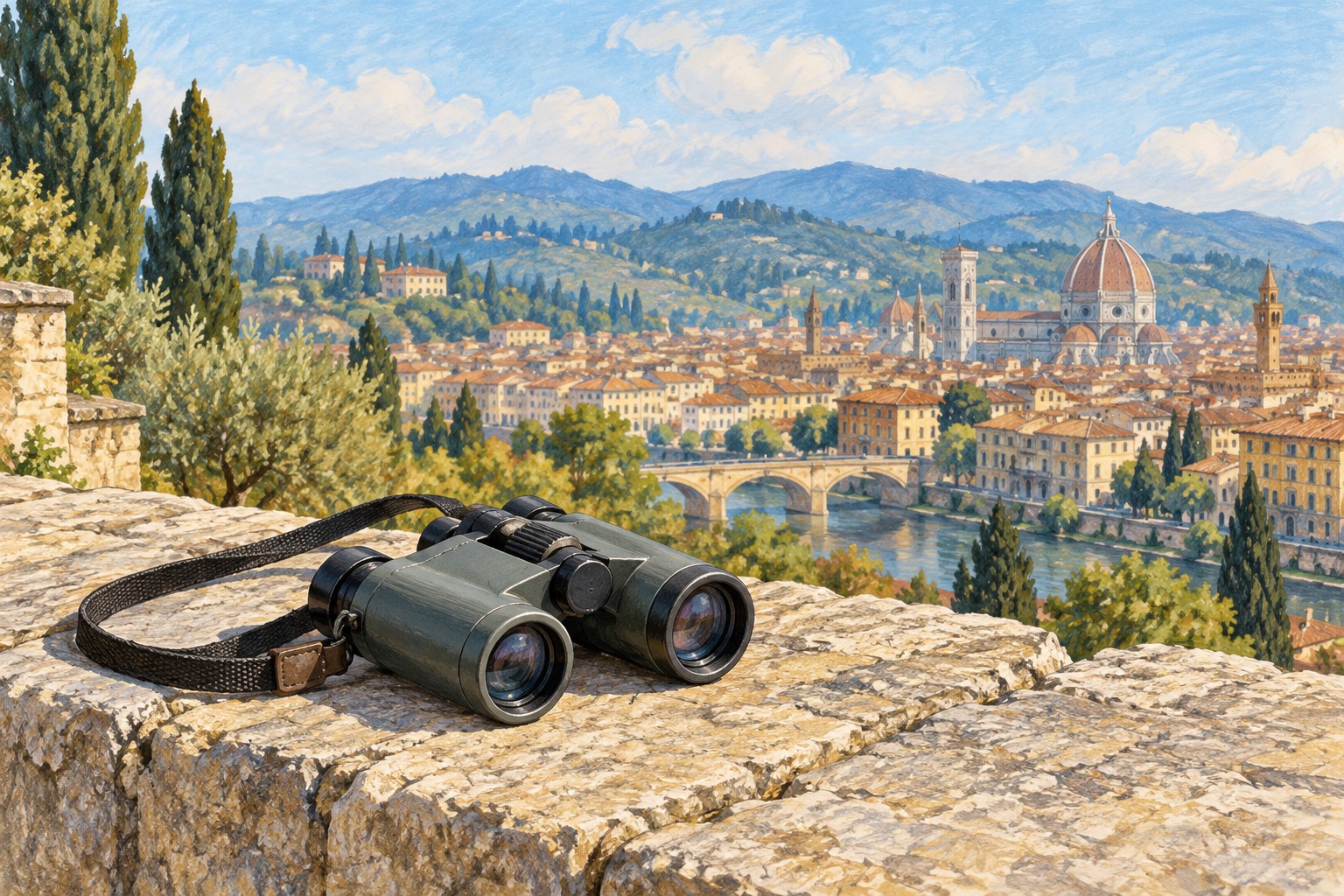
Compact binoculars can reveal details on buildings, across a lake or in a park. For travel, magnification matters alongside how easily you can find and hold a steady view.
Treat the numbers as a starting point
In a specification such as 8 × 25, the first number describes magnification and the second the diameter of the front objective lenses in millimetres. This provides an initial size reference, not a complete judgment of image quality. Models carrying identical numbers can still differ in handling, field of view and optical impression.
Greater magnification is not automatically more pleasant. Small movements may become more noticeable when hand-holding, and locating a detail can be harder. Try several suitable models on a distant object. For a city viewpoint, quickly finding a particular window or tower feature can be more useful than choosing the highest number in the range.
Test with your glasses and hands
If you wear glasses, try the binoculars while wearing them. Check adjustable eyecups and whether you can comfortably see the full field. The arrangement should not require constant switching between glasses, camera and bag. A retailer can explain how the particular model's adjustments are intended to work.
Hold the binoculars for several minutes and use the focusing control. Can you reach the wheels and adjust the spacing between the barrels? Very compact hinges help packing but may need more adjustment each time you take them out. A larger design is not automatically too heavy; the question is whether you would actually bring it on the planned walk.
For a shop comparison, locate the same distant detail through two models. Adjust each according to its instructions before switching. Notice how quickly you find the subject, whether the edges remain comfortable to view and whether you can hold the binoculars without gripping tensely. A brief look through a wrongly adjusted pair can produce a misleading judgment.
Repeat with a nearer object and the lighting actually available in the shop. This is not a complete laboratory test, but it gives a traceable impression of handling. Record specific observations such as an awkwardly positioned focusing wheel rather than making a broad claim about the best optical performance.
Define the observation task
A small pair may suffice for occasional looks across a square. Longer nature observations place more emphasis on comfort, field of view and steady holding. Consider whether nearby objects interest you as well. Minimum focusing distance then becomes relevant, and that value is not contained in the familiar two-number marking.
Check weather claims for the particular model. Water-resistant, weatherproof and waterproof under specified conditions are not interchangeable descriptions. Rubber covering does not automatically prevent water entering. Read use and care guidance and never point binoculars at the sun. Observation while travelling should also respect privacy and local access rules.
Remember the carrying arrangement
A suitable case should open without loose caps disappearing. Test the strap and avoid an arrangement that makes the binoculars strike a camera at every step. In a daypack, give them a consistent accessible place that does not require emptying the whole bag.
After an initial outing, note whether you actually used them. If weight kept them in the room, greater magnification will not solve that problem. If a compact pair was frequently useful but awkward to operate, look specifically for easier controls or a more comfortable shape. That creates a reasoned purchase decision rather than an upgrade for its own sake.